If you’ve ever seen a player take a charge under the basket only for the ref to wave it off and point to the floor, you’ve witnessed the restricted area in basketball come into play.
This rule might seem like a technicality at first, but it plays a huge role in player safety, foul calls, and how defenders can legally challenge shots near the rim. Whether you’re a seasoned fan or just starting to dive into the game, understanding what the restricted area is and how it changes the flow of the game adds a whole new layer to watching basketball.
So let’s break it down: what is the restricted area in basketball, why does it exist, and how does it affect the way the game is played at the highest levels?
What Is the Restricted Area in Basketball?
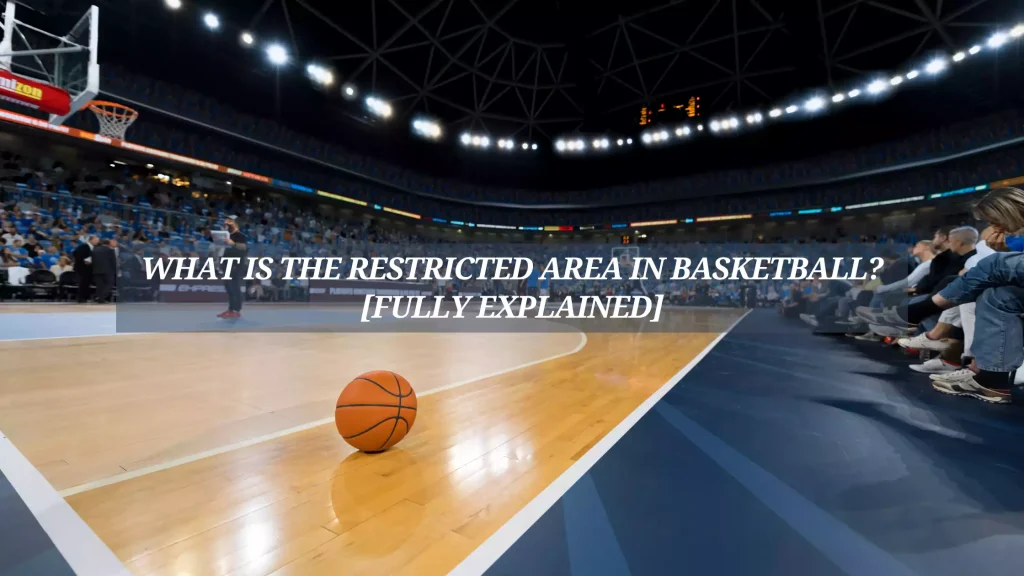
The restricted area is a semi-circular arc located underneath the basket in the paint. It’s drawn four feet from the center of the rim in the NBA and three feet in college basketball. The purpose of this area is to prevent defenders from drawing charging fouls too close to the hoop, where offensive players are most vulnerable.
In plain English: If a defender is standing inside this arc, they can’t legally take a charge. Any contact from a driving offensive player will almost always be called a blocking foul on the defender, not a charge.
This rule changes how defense is played near the basket and is crucial for both protecting players and encouraging more aggressive offensive play around the rim.
Why Does the Restricted Area Exist?
To understand why this rule matters, we have to go back to the basics of a charge call.
In basketball, when an offensive player barrels into a stationary defender who has established position, it’s typically ruled a charging foul an offensive turnover. However, over the years, defenders began planting themselves directly under the rim, hoping to draw charges from driving players who had no real way to avoid contact while going up for a layup or dunk.
This led to dangerous situations and an unfair advantage for defenders.
The restricted area was introduced to solve that problem to discourage defenders from sliding under airborne offensive players at the last second and to reduce collisions that led to injuries.
NBA vs NCAA vs FIBA: How the Restricted Area Differs by League
The rule around the restricted area exists across different levels of play, but there are key differences in its size and application depending on the league.
NBA (National Basketball Association)
- The restricted arc is 4 feet from the center of the rim.
- If a defender’s foot is touching or inside the restricted area, they cannot draw a charge.
- The rule is strictly enforced with video replay available for review.
NCAA (College Basketball)
- The arc is slightly smaller 3 feet from the rim.
- The rule works the same way: no charges can be drawn within that area.
- College referees also use video replay in late-game situations to confirm positioning.
FIBA (International Basketball)
- FIBA also uses a 4-foot arc, similar to the NBA.
- The restricted area is referred to as the “no-charge semi-circle.”
These slight variations can make a big difference in how the game is played at each level, especially for defenders who rely on drawing charges as part of their defensive arsenal.
How the Restricted Area Affects Charge and Block Calls
The charge vs block decision is one of the most controversial and game changing calls in basketball. That’s where the restricted area really comes into play.
Here’s how it works:
If an offensive player drives to the rim and makes contact with a defender who is standing inside the restricted area, the contact is automatically considered a blocking foul, even if the defender is stationary and appears to be in legal guarding position.
Why? Because the rule is designed to give the offensive player space to complete their move without fear of injury from last-second slides under the rim.
That said, there are exceptions:
- If the offensive player initiates the contact before leaving the ground, and the defender has already established position, the restricted area doesn’t apply.
- In transition situations, the restricted area may not protect the offensive player if the defender is clearly established before the drive begins.
These nuances often lead to coaches challenging calls during high-stakes NBA games, which makes the restricted area one of the most-reviewed zones on the floor.
Real-World Examples: Restricted Area in Action
Let’s look at a few moments where the restricted area rule came into play in meaningful ways.
1. 2018 NBA Finals – LeBron James vs Kevin Durant
In one of the most high-profile uses of the restricted area rule, Game 1 of the 2018 NBA Finals featured a controversial call when LeBron James appeared to take a charge on Kevin Durant late in the fourth quarter.
The play was reviewed, and the referees ruled that LeBron was in the restricted area when the contact occurred. The charge was overturned into a blocking foul, and the Warriors regained possession and momentum.
This call swung the game and arguably the entire series.
2. March Madness Moments
During the NCAA Tournament, restricted area calls can be especially pivotal. College players often attempt to draw charges to stop fast-break points, but if even a toe is on the arc, it results in a blocking foul.
These calls are often reviewed in the final two minutes of the game, making them a high-drama element of March Madness action.
The Impact on Modern Basketball Strategy
The restricted area isn’t just a rule for referees it changes how the game is coached and played.
Offensive Implications
For offensive players, the restricted area provides confidence to attack the rim. Players like Ja Morant, Zion Williamson, or Giannis Antetokounmpo thrive on their ability to slash to the basket. The restricted area gives them added protection from defenders looking to draw cheap charges under the rim.
It also affects how teams space the floor. Coaches often design plays to clear out the lane so that their star players can get to the basket without help defenders stepping into the arc and causing contact.
Defensive Implications
Defenders, especially help-side players, must be extra aware of where they’re standing when trying to block or contest shots near the rim. Timing becomes critical if they slide under the offensive player too late or stand inside the arc, they’re likely to be called for a foul.
Big men like Anthony Davis or Brook Lopez have adjusted their defensive styles to challenge shots vertically rather than relying on charge calls in the restricted zone.
How Players Train Around the Restricted Area
In today’s game, players are coached from an early age to recognize the restricted area and adjust their decision-making around it.
Guards learn to finish through contact, using floaters or reverse layups to avoid defenders stepping in late. Big men are drilled on verticality, going straight up rather than leaning in to draw contact.
Defenders are taught to either get in position outside the arc or go for blocks without risking a foul.
In the NBA, where every point counts, a single call in or out of the restricted area can mean the difference between winning and losing.
Why the Restricted Area Rule Matters
The restricted area rule might not be as flashy as a buzzer-beating three or a highlight-reel dunk, but it plays a crucial role in today’s basketball landscape.
Here’s why it matters:
- Promotes player safety by preventing dangerous collisions
- Rewards aggressive offensive play near the rim
- Clarifies charge/block decisions for referees
- Encourages vertical defense and smarter positioning
- Reduces controversial calls by giving refs a clear visual guideline
It’s one of the game’s subtle mechanics that ensures fairness and flow, especially as basketball becomes faster, more physical, and more high-stakes at every level.
Small Arc, Big Impact
So, what is the restricted area in basketball? It’s a simple line under the basket that creates a safer, fairer, and more dynamic game. It impacts how players drive, defend, and strategize around the most critical scoring area on the court.
Whether you’re watching the NBA, NCAA, or international play, keep an eye on that little arc under the hoop. It may look minor, but it plays a major role in the outcome of games and the careers of players who play above the rim.