Baseball is a sport full of statistics, where every pitch, swing, and run is analyzed to assess performance. One of the most important stats used to evaluate pitchers is WHIP, which stands for Walks plus Hits per Inning Pitched. For fans, players, and even bettors, understanding what makes a good WHIP is key to gauging a pitcher’s effectiveness.
In this post, we’ll dive into WHIP, explaining why it’s important, how to interpret it, and its role in evaluating pitchers in Major League Baseball (MLB).

What Is WHIP in Baseball?
WHIP stands for Walks + Hits per Inning Pitched. It’s a statistic used to measure a pitcher’s ability to prevent batters from reaching base. It shows how many baserunners a pitcher allows per inning, combining the effects of both walks and hits.
The formula to calculate WHIP is:
WHIP = (Walks + Hits) / Innings Pitched
Here’s what each part of the formula means:
- Walks: When a pitcher walks a batter, the batter reaches first base without having to swing at a pitch in the strike zone. Walks give batters a free pass to base, which increases the chances of the opposing team scoring. A pitcher’s control is key in limiting walks.
- Hits: Hits are a big part of a batter’s success. A pitcher who gives up more hits is putting more runners on base, raising the chances of those runners scoring. The type of hit—single, double, triple, or home run—can differ, but all are harmful when it comes to WHIP.
- Innings Pitched: This is the total number of innings the pitcher has completed. The more innings pitched, the more reliable the WHIP statistic becomes, giving a clearer picture of the pitcher’s performance over time.
Why Is WHIP Important?
WHIP is an important stat because it shows how well a pitcher prevents batters from reaching base. Unlike other stats, like Earned Run Average (ERA), which tracks the number of runs a pitcher allows, WHIP focuses on how often a pitcher puts runners on base, regardless of whether they score.
Here’s how WHIP compares to other stats:
- ERA shows how many earned runs a pitcher gives up per nine innings, but it doesn’t consider how many runners are put on base.
- WHIP gives a clearer picture of a pitcher’s control and efficiency, while ERA can be affected by things like defensive errors or other factors outside the pitcher’s control.
For fans, understanding WHIP helps evaluate how well pitchers perform over different seasons. Fantasy baseball players find it useful for choosing players, and MLB bettors often use WHIP to assess pitcher matchups, making it an essential tool in sports betting.
What Makes a Good WHIP in Baseball?
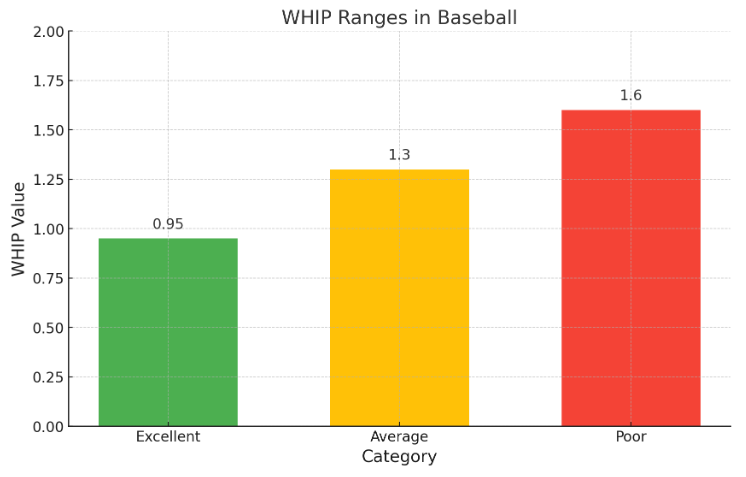
A good WHIP can vary depending on the pitcher and the situation, but here are some general guidelines:
- Excellent WHIP: Below 1.00. This is outstanding and often seen in top pitchers like Pedro Martinez (0.92 in 1999) and Clayton Kershaw (1.00 career average).
- Average WHIP: Around 1.30. This is close to the MLB average. A pitcher with a WHIP in this range is solid but may struggle against top-tier teams.
- Poor WHIP: Above 1.50. A WHIP this high suggests a pitcher is allowing too many baserunners, which can lead to a higher ERA and difficulties in close games.
Some legendary pitchers with low WHIPs include Addie Joss, who holds the MLB record for the lowest career WHIP at 0.97, and Jacob deGrom, who currently has a career WHIP under 1.00. However, it’s important to remember that things like league averages and changes in baseball over time can influence what is considered a “good” WHIP.
Factors That Affect WHIP
Several factors affect a pitcher’s WHIP, making it a flexible statistic:
- Control and Command: A pitcher’s ability to throw consistent strikes, avoid walks, and place pitches accurately can have a big impact on their WHIP.
- Pitching Repertoire and Strategy: A pitcher with a diverse set of pitches and smart pitch selection can keep batters guessing, leading to fewer hits.
- Defense: A strong defense can help reduce hits by making key plays, while a weak defense may cause a pitcher’s WHIP to rise.
- Pitcher’s Skill and Experience: Experienced pitchers often have better control and a stronger understanding of hitters, which usually results in lower WHIPs.
- Ballpark Factors: Some stadiums favor hitters, leading to more hits and higher WHIPs. On the other hand, pitcher-friendly parks can help lower WHIPs.
What Doesn’t WHIP Measure?
While WHIP is a useful stat, it has some limitations:
- Quality of Hits: WHIP treats all hits the same, whether it’s a solid double, a bloop single, or a home run. This means some hits, which are more damaging, are counted equally.
- Defensive Errors: WHIP doesn’t factor in unearned runs or defensive mistakes. A pitcher may have a high WHIP if their defense isn’t strong, even if they pitched well.
- Strikeouts and Double Plays: WHIP doesn’t show how well a pitcher can get strikeouts or induce double plays, which are important for preventing damage in innings.
To get a more complete picture of a pitcher’s effectiveness, it’s helpful to look at other stats like ERA (Earned Run Average) or FIP (Fielding Independent Pitching), which focus on a pitcher’s performance, independent of defense.
How to Improve WHIP: Strategies for Pitchers
To improve WHIP, pitchers can focus on several key strategies:
- Control and Accuracy: Reducing walks is important. Pitchers should aim to avoid giving free passes by consistently hitting their spots with precision.
- Pitch Selection and Strategy: Having a variety of pitches, including effective off-speed and breaking pitches, can keep batters off balance and limit hits.
- Mental Toughness and Focus: Staying calm and focused under pressure helps pitchers avoid giving up free passes or hits in high-stress situations.
- Conditioning and Mechanics: Good physical conditioning and consistent mechanics help pitchers stay sharp and avoid issues like fatigue, which can lead to a higher WHIP.
- Defense Collaboration: Communicating with fielders to ensure proper defensive alignment can reduce the number of hits allowed.
Who Has the Best WHIP in MLB History?
The record for the lowest career WHIP is held by Addie Joss, who posted a 0.97 WHIP during his short but impressive career. Modern pitchers like Jacob deGrom (0.99) and Clayton Kershaw (1.00) are also among the best in this stat.
Addie Joss’ achievement remains a benchmark for future pitchers aiming to dominate in WHIP, with current players still trying to reach this remarkable milestone.
WHIP and MLB Betting
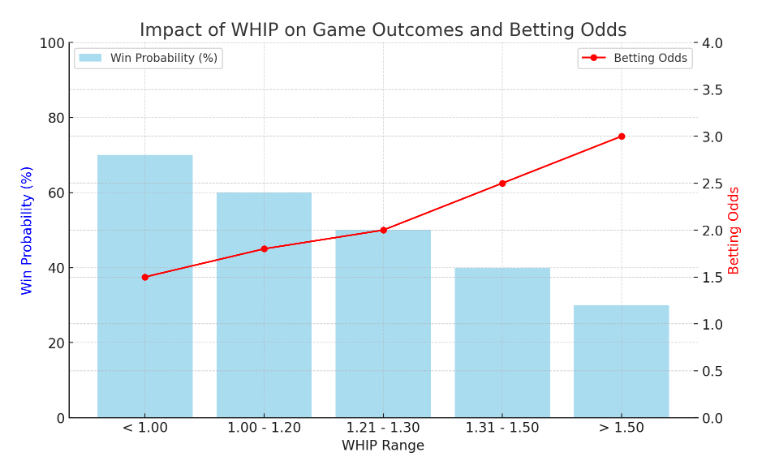
For bettors, WHIP is an important stat to consider when evaluating pitcher matchups. A pitcher with a low WHIP is usually better at limiting baserunners, making them a safer bet in important games. Sportsbooks and betting sites often show detailed WHIP stats, helping bettors make smarter choices.
If you’re betting on MLB games, knowing a pitcher’s WHIP can make the difference between a winning and losing bet. Websites that provide detailed pitching stats, including WHIP, can help improve your betting strategy.
| WHIP Range | Win Probability | Betting Odds Impact |
| Below 1.00 | High | Favorable (Lower Risk) |
| 1.00 – 1.20 | Moderate-High | Favorable (Balanced Risk) |
| 1.21 – 1.30 | Average | Neutral (Even Odds) |
| 1.31 – 1.50 | Moderate-Low | Unfavorable (Higher Risk) |
| Above 1.50 | Low | Unfavorable (High Risk) |
Conclusion
WHIP is a valuable stat that shows a pitcher’s ability to control the game by limiting baserunners. A good WHIP, typically below 1.00, is a sign of an elite pitcher, while a poor WHIP may suggest struggles with control. Understanding WHIP and the factors that influence it helps fans, players, and bettors gain a better understanding of a pitcher’s performance.
Whether you’re choosing players for fantasy baseball, placing a bet on a game, or just trying to learn more about pitching, keeping track of WHIP is a helpful tool. Pay attention to this stat to appreciate the skill, strategy, and mental toughness required to succeed on the mound.
So, the next time you watch a game or make a bet, remember to consider WHIP—it’s not just a number, but a key to understanding a pitcher’s mastery of the game.